News

Select Date

PRC Therapist Emily Soiney contributed to my summer weekly reading series this week when she shared an article with me over the weekend! The Association Between Asymmetric Hip Mobility and Neck Pain in Young Adults was recently published in the Journal of Manipulative and Physiological Therapeutics by Lee et al. Unfortunately this article is not available free online, however you can purchase the text here!

The summarize, the objective of this cross-sectional observational study was to determine whether asymmetric hip mobility was associated with neck pain in young adults. They evaluated hip ROM using the Patrick’s FABERE test on 327 freshman university students (48 in the neck pain group). The results indicated that the frequency of asymmetric hip mobility (FABERE test results) among the students who reported chronic neck pain was significantly higher than that of those without neck pain. The concluded as a result of their study, that imbalanced mobility of the hip joints might be associated with an increased incidence of neck pain.

Needless to say, this article has been added to the PRI Resource Library! Thanks again Emily for sharing it with us!

It’s so hard to believe that it is already August 1st! Where has the summer gone?

This comes as a reminder that applications for the PRI credentialing programs, Postural Restoration Certified (PRC) and Postural Restoration Trained (PRT) are quickly approaching! PRC applications are due on September 15th, and PRT applications are due on October 15th.

Are you nearing completion of your PRC or PRT application? If so, there are benefits to submitting your application early! Some benefits include:

  • Early submissions are given to the review committee immediately, and feedback is returned to the applicant within 6 weeks!
  • Stress-free life (from your application at least) for the remainder of the summer! 
  • After you hear from the review committee, you are able to begin planning your travel arrangements for the PRC or PRT testing process, and hopefully get some great travel deals!

A couple PT’s have already submitted their PRC application, and have received feedback from the review committee. I am sure they are relaxing by the pool now!

Are you interested in hosting a PRI course in 2014? I am still in the process of planning the 2014 course schedule, and there are several dates still available! If you are wanting to host, please contact me as soon as possible or fill out the Host A Course form online!

This week I came across a good reference article on hamstring injuries, The Management of Hamstring Injury – Part 1: Issues in Diagnosis. The discussion on anatomy and biomechanics is well written, as is the section on body mechanics. Great to see some discussion on the influence of lumbar-pelvic mechanics! If you are interested in the etiology and rehabilitation of hamstring injuries, this article also has an extensive reference list!

In relation to this article, I have also attached another reference, Hamstring Injuries Require Triplanar Assessment co-authored by Ron Hruska for Biomechanics in 2003.

Jason Masek, MSPT, ATC, CSCS, PRC recently presented at the NATA Annual Meeting & Clinical Symposia in Las Vegas. His presentation “Breathing’s Influence on Upper Quarter Dysfunction” is attached HERE!

I have also attached a video clip that Jason used in his power point presentation which demonstrates the effect that rib position and respiration have on shoulder function.

YouTube video

Well, things have been busy with traveling to Las Vegas for the NATA convention and the 4th of July holiday last week, but I am back with more reading resources in the summer reading series! This week, I have chosen to highlight a book, “Nature Knows Best”. While I am sure those of you who have been around PRI for several years have already read this book a time (or two even), those who are newer to PRI may not have experienced this book. The PRI Resource Center has two copies of this book…..because that’s how good it is!

“Nature Knows Best” by Jonathoan Isbit is all about squatting, and I am not talking about what you see in a weight room, but the “natural squatting position” or as it is referred to in the Pelvis Restoration and Impingement & Instability courses, a “Functional Squat.” I first came across this book while I was still a student in PT school, and it was such a quick and refreshing read (took maybe an hour or two to read the entire book).

So, if you are interested in learning about the (many) benefits that squatting has on our health, I would order this book for a quick summer read!

Josh Olinick, DPT, MS, PRC was first introduced to Postural Restoration® as a student at Elon University. He recently opened a private practice, STEPS For Recovery in Cary, NC, where Josh and his wife specialize in outpatient neuro physical therapy. To read more about Josh, CLICK HERE!

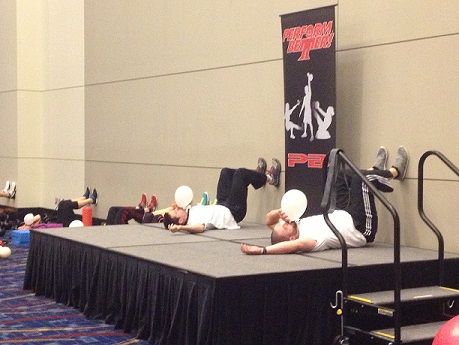
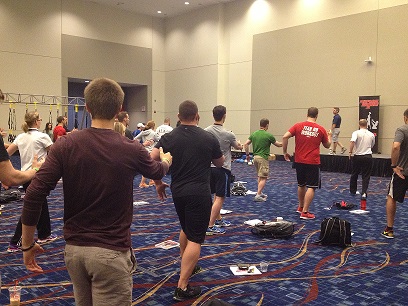
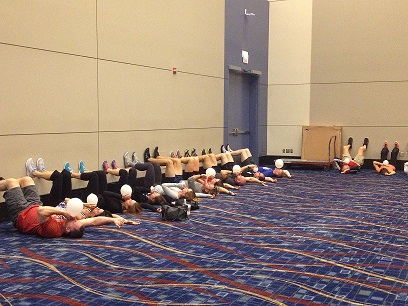
This past weekend PRI had a booth at the Perform Better Summit in Chicago, IL. PRC Michael Mullin had a hands-on and lecture presentation during the Summit, which brought together 800 trainers, coaches and therapists from across the country. I had the opportunity to sit in on both of Michael’s great presentations, which were titled ” Principles of Postural Restoration for the Sports Clinician.” I had the chance to talk with many professionals who have heard about PRI through various blogs and websites, and I also met quite a few people who have already taken our courses!

Please click here to see Michael’s presentation!

We are SO excited to show you this recent published article on the “Clinical Application of the Right Sidelying Respiratory Left Adductor Pull Back Exercise”.  Kyndall Boyle,PT, PhD, OCS, PRC does a fantastic job describing why this technique is used and what outcome it achieves.  Check it out HERE!

Did anyone hear Jason Masek speak at the NATA convention?  Tell us about it!

This week’s featured article found in the PRI Resource Center is “Occlusion, orthodontics and posture: are there evidences? The example of scoliosis.” If you integrate with a dentist or orthodontist, or would like to learn more about the relationship between posture and occlusion, be sure to check out this article. In addition to providing correlations between indiopathic scolios and dento-skeletal characteristics, this article is a great systematic review referencing nearly 100 articles related to this subject!

Last weekend we were able to spend a couple days with the faculty of PRI.  What a great couple of days spent discussing course development, clinical updates, the upcoming year and how much we all appreciate one another!  We thought we would share a couple pictures from the weekend!

Subscribe to our Newsletter