News

Select Date

“Innovations in Spinal Deformities and Postural Disorders” was just released on September 27th. We are so proud of Susan Henning, Jean Massé and Lisa Mangino from Advance Physical Therapy in Chapel Hill, NC, who spent countless hours summarizing their clinical experience utilizing Postural Restoration® with scoliosis and other spinal dysfunctions! Chapter 7 titled “Postural Restoration: A Tri-Planar Asymmetrical Framework for Understanding, Assessing, and Treating Scoliosis and Other Spinal Dysfunctions” is sure to be a popular reference for all PRI professionals who work with patients or clients with curvature of the spine.

I had a chance to get a little more information on Susan’s path of learning and teaching about scoliosis. She began her dive into and interest in scoliosis after attending the Advanced Integration course over 10 years ago, and shortly after she attended a Schroth Method course which expanded her focus and insight into working with that population. In 2014, Susan presented at our Annual Interdisciplinary Integration, where her presentation focused on the similarities of the Schroth and Postural Restoration® methodologies.  While attending the International Society on Scoliosis Orthopaedic and Rehabilitation Treatment (SOSORT) meeting in 2016, Susan was introduced to Josette Bettany-Saltikov, PT, PhD, and she had the opportunity to introduce her to some of the PRI concepts. Josette began writing “Innovations in Spinal Deformities and Postural Disorders” with Dr. Sanja Schreiber and they asked Susan to contribute a chapter on Postural Restoration®. After the abstract for the book was accepted, Susan brought her colleagues Jean and Lisa on board to help write the chapter. They ended up finishing it in only 6 months! We are so thankful for all of the hard work they all put into making this chapter a reality.

We are also excited to have Susan, Jean and Lisa teaching the scoliosis section (day 4) of the Advanced Integration course this year, and in future years. If you are working with patients who have scoliosis, be sure to check out this chapter, and register for the Advanced Integration course! Their expertise of curvatures of the spine will provide course attendees with new material on treatment for non-pathological and pathological scoliosis curves, juvenile kyphosis and torticollis.
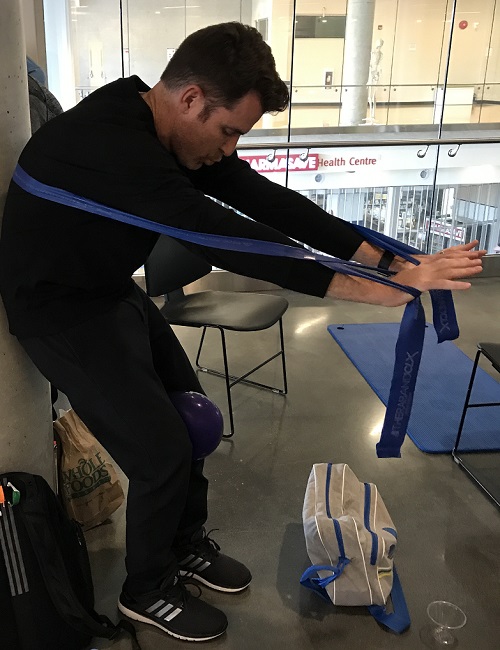
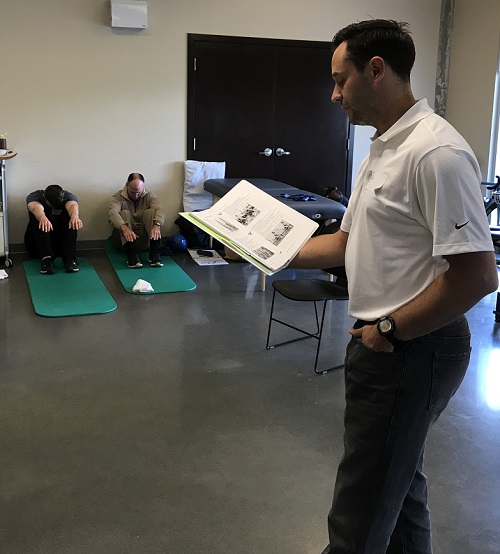
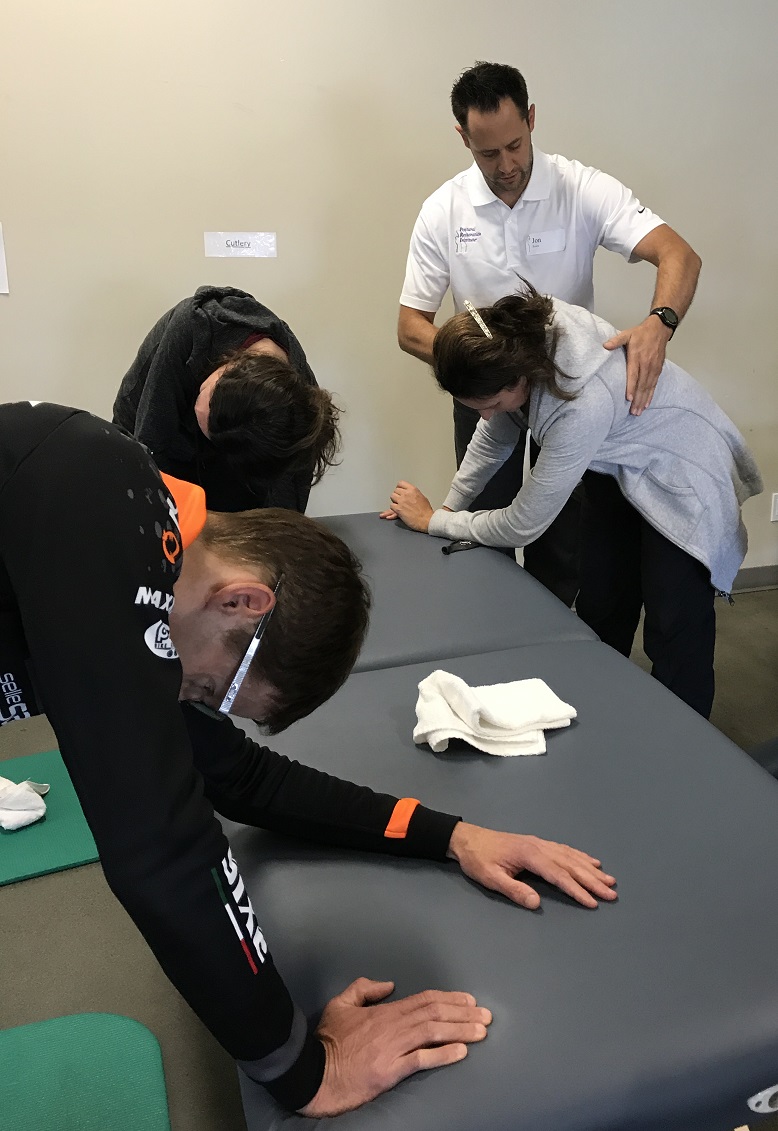
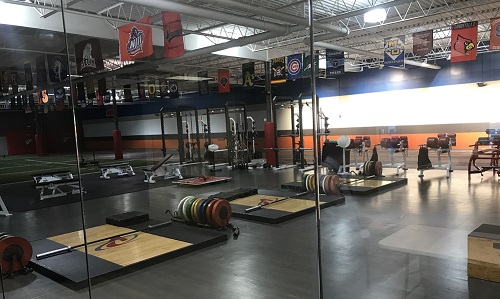
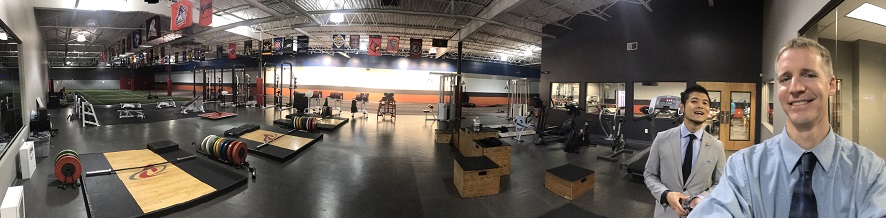
Fortius Sport and Health in Vancouver is not only a world class Mecca for athletes wanting to perform at the highest level and for patients recovering from an injury, but it is also a practitioners dream location for a progressive, state-of-the-art, and integrative environment to work in and hone their professional skills. Fortius was developed as an enormous community based sport rehab and facility in the suburb of Burnaby, near Vancouver, that includes several ice rinks, grass fields for field sports and a world class weight training facility including basketball courts and therapy pools. There is a vision center for concussion rehabilitation. Physical therapists, chiropractors, athletic trainers and sport performance specialists all work in an environment that is focused on mutual respect and collaboration to provide the very best in athlete/patient outcomes. Regular meetings are scheduled with all practitioners to discuss cases including having medical consultations available for athletes. This group of practitioners that attended, many of which were from Fortius, had their first introduction to PRI this weekend. One husband and wife team from the US had taken Postural Respiration through a home study course and loved it so much that they opened up their new clinic based on breathing and respiration principles. This was their first live course for Postural and having a hands-on experience was invaluable from their response. Jon Rowe, CSCS, PRT is the only PRT/PRC in Canada and drove 4 hours through the mountains to assist this weekend from a town called Kelowna. Jon is a quiet force and by Sunday was providing an amazing amount of insight and help to new students. Some of the questions that came up included what does PRI teach in terms of breathing? Well, let’s just start with an ability to exhale fully and pause before taking a full breath in. Combine that with a new neurologic and bio-mechanical re-position or non-manual technique and now unlocking the secrets to a balanced bi-lateral human being is possible. It seems simple to veterans of PRI that if you hope to master breathing, you must see for starters that a left hamstring, glute, IO/TA’s are needed to create a left (and right) ZOA of a diaphragm. All the breathing techniques in the world aren’t going to re-position, re-train or restore function and performance without this basic building block. This one concept was reinforced though out the weekend. Many thanks to Ryan Murray, DPT and Erik Torchia, DPT for hosting this weekend in such a beautiful facility, city and country.

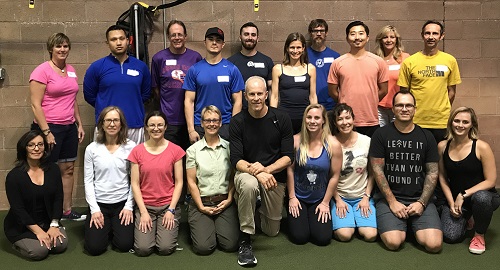
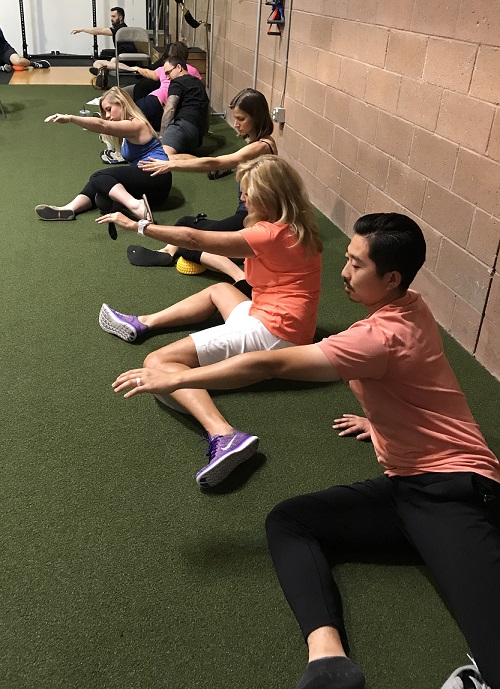
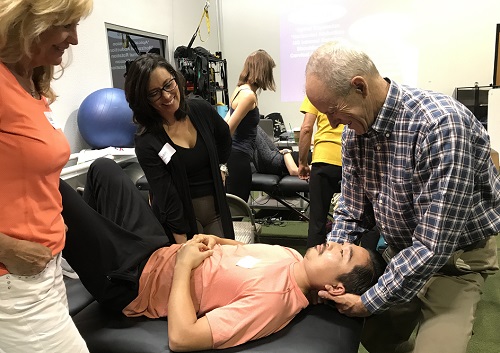
This past weekend I enjoyed, and loved, my time with nearly forty movement scientists in the city of brotherly love. I enjoyed having a tremendously diverse group of professionals, from personal trainers like Aven Johnson, OTR’s like Wing Chin, Exercise Physiologists like Bryant Aguilar, Pilates Instructors like Susan Milosky, Inpatient Neuro PT’s like Christopher Carroll, PTA’s like Dustin Friesen, Associate Professor/ATC’s like Nicole Cattano, and PT’s like Matt Hinsey and Jessica Jennings. My time in Philadelphia and nearby suburb of Cherry Hill, NJ hosted by Jon Herting and TTR Performance was a great experience, my first at this location. Jon and his team allowed me to be dialed solely into the task of introducing nearly 30 PRI hatchlings to the science!

This weekend was especially unique because we were honored to have lab assistants Jon Herting as well as Takashi Onuki, MS, ATC, CSCS, PES, PRT, PRI coordinator in Japan and budding PRI Instructor. I had the opportunity to hang with this future faculty member and daddy of daughters who brought a great teacher’s perspective that I was able to appreciate and learn from. Thanks Takashi!

Through this course, we discussed the normality of asymmetry, the group of "amigos" that we use to oppose a right lateralized system, with some great conversation and discussion via an interactive group of professionals about how to implement PRI principles from the "it’s all neural all the time" hemiparesis client to the "it’s game on all the time" competitive athlete setting. Thank you Elizabeth Young, Ken Guzzardo, Brian Dougherty, Ray Carr, Connor "CJ" Conway, Anthony Blubello, Tara Amato, Ryan Wolff and Courtney Pierre for your assistance with demonstration of PRI techniques and treatment strategies! You all made the course real! Thank you Zach Mitchell, Colin Kidwell and Rushi Shahiwala for keeping a steady flow of good questions for discussion flowing. Lastly, thank you "table Jay", Jennifer Bolster, Jimmy Jo among many others for enjoying a laugh here and there during the course.

Overall, much was learned, and much brotherly (and sisterly) love was doled this weekend. Thanks for everything Jon and the Philly crowd!

The Institute of Community Wellness and Athletics (ICWA) hosted Postural Respiration in Albuquerque, NM Sept. 9-10. This course was a faculty member’s dream! Most of the class attendees were brand new to PRI or had only taken Myokin or a home study course previously. From the very start, the curiosity and attention was palpable and students followed closely every step of the way into a PRI weekend journey of challenge and discovery. Questions were plentiful with great re-states of concepts and honest feedback that, yes, the amount of information in this course can feel daunting for first time attendees but they wanted to hang in and work hard to really get it! The questions directed repetition from many angles that led to understanding of the basic principles of PRI. One of the many topics that vexes new attendees ( It certainly vexed me at first!) is Superior T-4 Syndrome. What helped was a strong foundation that everyone absorbed on rib kinematics driving a spinal column and that ribs are driven by respiration and respiration is driven by neurological patterns. These guys got it. What helped for the strength and conditioning group was that scalenes are like "Romanian Dead Lifters" lifting upper ribs creating a patho-mechanical pattern of respiration. Before lecture on James Anderson’s page 50 in the Appendix on Thoracic Airflow, Typical BC and Superior T-4 Syndrome, the class had had a demonstration on a "long tall Sally/Sam" that demonstrated BC testing, then manual restoration techniques including Superior T-4 technique to assess for Superior T-4 Syndrome and then identifying when and why a manual Subclavius Release is needed. Then they assessed and practiced the two manual techniques after being shown what the reasoning behind the assessment and manual approach. The lecture into Page 50 just made sense to these new students since they could apply a concept to actual experience that they just practiced in lab and could now apply since they had a better picture in their minds as to what patho-mechanical respiration is and how to identify and treat with manual and non-manual techniques. The enthusiasm, especially on Sunday afternoon after an information/paradigm changing weekend can feel over-whelming, was just great. Thank you Nathanael Smith and Jonathan Esquibel for being great site hosts and especially Jessica Kisiel, PRT for assisting! In this faculty member’s opinion, New Mexico will be a great new state for PRI and I hope to be invited back! Myokin will be there February 2018!

If someone were to ask me to describe the ideal setting, attendees, topic, and timelines for a PRI Course that I would want to organize and create, I would have responded the following way.   First, I would truly like to instruct and teach in our PRI home, our Institute, our place of study, work and fun, our resource center, our reference center, and our service center where we can serve nourishment both in the form of food and didactical discussion.   Second, I would invite a mix of course attendees and disciplines that were new to PRI; and some that took the first offered PRI courses offered years ago. (Joan Hanson and Lori Thompsen you will always remain young in my heart and mind).  Third, I would limit the class to 20 attendees to maximize the individual interaction and participation.  Fourth, I would want to have lunch with all of them and talk about things that they wanted to talk about with me. Fifth, I would pick objectives and subject matter related to the head, neck, teeth, vision, and neuro-patterning.   Sixth, I would hold the course on a Friday and Saturday and I would do it at the astronomical beginning of spring in the Northern Hemisphere or mid-March.   And finally, I would like to participate with some professionals that I work with in this community, since I lecture and talk to so many attendees, that work in different disciplines and also in different communities.   Pat Brinkman-Falter BSDH, MS, RDH,CO,  Susan Christiansen DDS,  Janae Greer PT, DPT,  and Charissa Johnson PT,ATC, thank you for coming to this community educational course.   I respect and appreciate you all so much.   I look forward to each and every course that is hosted here in Lincoln Nebraska, home of the PRI minds.  

Jen Poulin, one of PRI’s veteran faculty members, told me that this group of attendees would be great to present to. She was spot on and this group assisted by Carolyn Weber, PT, PRC and Holly Spence, PT, PRC was most engaging and enthusiastic . There were physical therapists that either worked in a hospital setting, private practice or with local ski teams. Former ski racers, now turned physical therapists and mentors that were new to PRI got the concepts immediately and could see applications for their athletes as well as general populations. As always, the questions asked were intelligent and challenging backed by a strong drive to learn and explore new concepts and practical applications of a previously unknown science to many in the room. Also in attendance was a DC/PT, athletic trainers and strength and conditioning professionals. Vermont has a great audience and already has another PRI course scheduled for next year. Many thanks to the staff at Northwestern including Karen Staniels and Christy Cushing. Thanks again to Carolyn and Holly for your help!

Go Cats Go!! What fun this course was for me! But I guess they all are in one way or another huh? But… 25 years ago this May I graduated from the University of Vermont as a bright eyed and bushy tailed PT ready to take on the world. It is so nice to still be so bright eyed about my profession. Vermont, as most of you know is special to me, not only because I graduated from UVM, BUT both Chris (my husband) and I grew up in VT so going here to teach is also going home. I enjoyed a beautiful spring weekend. The trees were budding and so was the interest in learning about PRI. I had a great time with this group of PT’s, ATC’s, Strength Coaches, Massage Therapists, Wellness providers and one very special DC that I only wished I had more time to talk to about PRI.

I had the privilege of working with two friends and fellow PRC’s Holly Spence and Cory Healy as my lab assistants. These two are Pros and made my time that much more enjoyable.

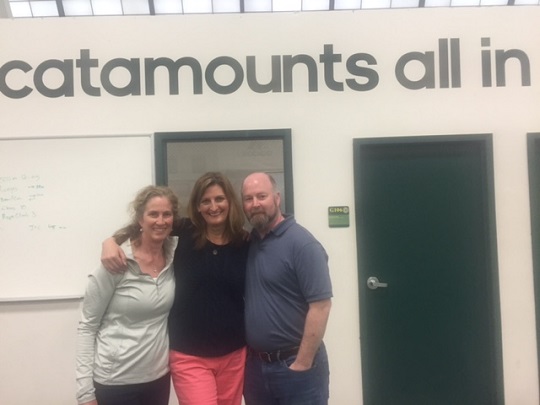
What was even cooler was 3 soon to be DPT’s ready to graduate from UVM in just a few weeks were in the front row!  See “The Future of PT” and me pictured below.  Good luck to Johnny, Kathleen and Natalie from the Class of 2016! 

The UVM Athletic Medicine staff is also dear to my heart as my husband is a former consultant and teammate of the current staff.  Many a nights were spent cheering on the Catamounts. I was so thrilled to meet their new staff and see some familiar faces. Looking forward to helping the UVM staff take their student athletes to new heights with PRI in the mix. 

I just returned from our largest state, where I thoroughly enjoyed my time with a group of energetic learners.  Joy, Katie and Tracey at The Physical Therapy Place were tremendous hosts on all fronts!  This class had a great discussion about integration of femurs and a thorax by way of establishing frontal plane control of the inlet and outlet of the pelvis for our clients in various settings.  Control the pillars, inhibition tools plus integration atop said inhibition were a couple of the topics we enjoyed discussing as part of this course.  There were so many people who I enjoyed the process with this weekend!  Thank you Alaska folks for proving to be a very inviting group of learners for this instructor from the “outside!”  

After a 3 month break in my teaching schedule, I was well rested and excited to get back to spreading the good news of PRI!  I was met with the challenge of having a large group of new clinicians to the science of PRI.  We jumped deep into the rabbit hole of the Left AIC pattern and climbed up some trees in the forest of Myokinematics of the Hip and Pelvis.  This was a great group of approximately 40 “PRI newbies”.  What a way to get it back going!  They were patient with me as I shifted their way of thinking about hip pathologies to a more global way of understanding neurological patterns and how that affects position, performance and pain of the hip. 
Welcome to the #PRINATION!  Y’all are “newbies” no more!

Teaching at Finish Line Physical Therapy this weekend was so rewarding for many reasons. Spending time with old friends and making new friends at this course was as rewarding as spending the entire weekend with Mike Cantrell. We both learned so much from each other and were fueled by the passion of those who pursue and practice PRI applications. I really enjoy teaching Cervical Revolution and am excited for anyone taking the course in the future regardless if a Georgian or a Nebraska farm boy teach it!

Jason Masek, ATC, CSCS, PT, PRC spoke at the 2015 NCSA Coaches Conference January 9 in Louisville, KY. He spoke about how posture begins with proper rib cage position, which leads to better breathing and ultimately, better athletic performance. He emphasized how the postural position that you start in will affect the position that you end in. Hyperinflation and how to manage athletes with this problem was also discussed. Watch the video HERE.

Lori and I enjoyed our time and journey teaching Pelvis Restoration with the group of movement enthusiasts at Rebound Sports Physical Therapy this past weekend.  An engaging and fun group whose particular attention to clinical and on-field applications of pelvic inlet and outlet position will be applied readily. Inhibition and detecting the best time to inhibit based on special test findings was a good topic covered in detail.  Thanks again to all who attended and helped make this weekend a snowy, enjoyable event for all!

Subscribe to our Newsletter