
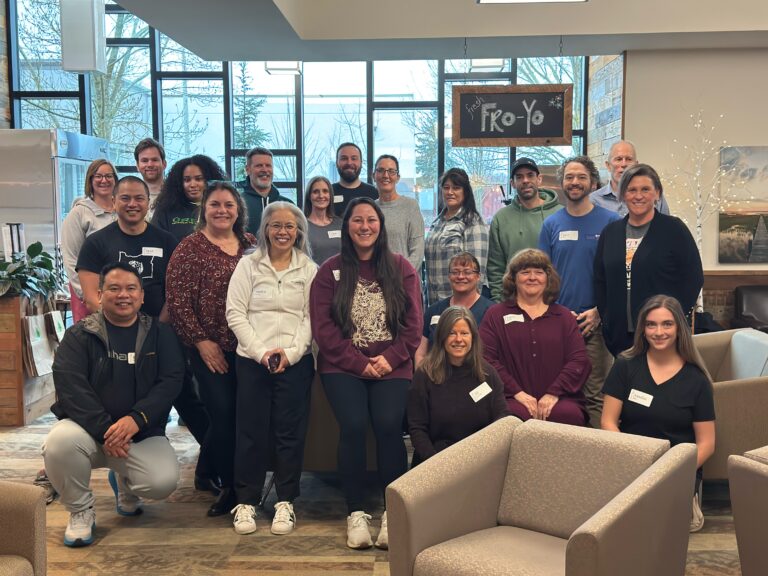
First Call Home Health in Salem, OR was the location of Postural Respiration to a group of physical therapists, an occupational therapist, an athletic trainer and strength and conditioning personnel. The majority of the the students were either new to PRI or new to Postural Respiration which made for a level playing field for most of the class to learn the basics and essentials of the Postural Restoration Institute. Having so many new people to the science of PRI is an opportunity to lay a foundation for a new paradigm of patient understanding and care, even for the most seasoned veteran to their particular practice.
For new attendees day one of Postural Respiration, or any PRI course, opens the door to a new way of thinking about patient assessment and treatment that is exciting and to a degree a little daunting as asymmetrical anatomy and patterns of breathing and movement are described in an observationally and evidence based manner. A central tenet in PRI is that we are all, universally, anatomically asymmetrical. The two sides of the body may look from the outside the same while inside we are different, left versus right, and this affects how we move, breathe, and function as a human being in our own unique way.
Asymmetries are a gift for movement and what this class really got was that an over-reliance on one side of the body needs to be recognized and managed or end-range dependence results while pain and pathology may follow. In fact. most of the patients that present to our offices share a similarity that an end-range reliance to one side of their body expressed in many unique and varying degrees will result in pain and/or pathology.
This course explores the relationship of the abdominal wall and the diaphragm, ribcage, pelvis and the form and function of the thorax or how we deliver air pressure sense into our thorax. One of the most unique topics in this course is that breathing and management of airflow may develop a pathologic pattern affecting every physiologic system in the human bod and defined as SuperiorT-4 syndrome. Superior T-4 is a result of an overuse of accessory muscles of respiration, especially muscles in the neck, that disrupts airflow into a chest wall that limits the ability for quiet breathing, movement, and dynamic posture.
It was determined that one of the students was in fact breathing, moving, and managing gravity with Superior T-4 Syndrome and after a complete treatment guideline assessment including non-manual and manual techniques. After treatment demonstration, his PRI functional tests cleared from positive to negative illuminating a sophisticated approach to patho-mechanical breathing that can potentially have long term health and movement consequences.
This was a great group and the majority of students were from First Call Home Health. They are adding PRI to their culture of clinical skills and have more courses scheduled for this year and next as their PRI curiosity and competence is growing. I want to thank the students who travelled from Washington, California, and distant parts of Oregon. I especially want to thank Dan Arnold, PT and First Call Home Health for being the “anchor contact” and hosting these two days. I want to thank Minh Nguyen, OT, PRC, a veteran PRI practitioner, for lab assisting and adding his time and energy to facilitate everyone’s learning experience. And thank you to all of the students with your questions and enthusiasm for a rich and rewarding experience of Postural Respiration.
– Skip George