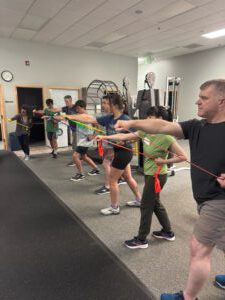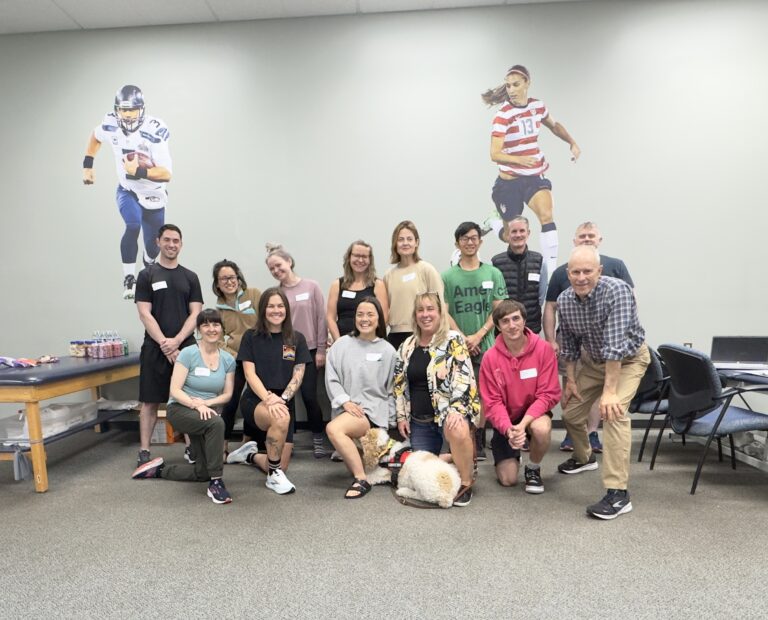
The Seattle area has a vibrant PRI community of practitioners expanding their PRI knowledge and application. Just east of Seattle is the community of Sammamish and I had the privilege of presenting Postural Respiration to a diverse group of physical therapists, a chiropractor, a respiratory therapist/acupuncturist, yoga instructor, and strength and conditioning personnel.
While three of the students were brand new to PRI, most of the attendees were new to Postural Respiration having taken either Pelvis Restoration or Myokinematic Restoration. The two strength and conditioning attendees are currently preparing for their PRT certification and several of the physical therapists are pelvic floor specialists that added a critical dimension of integrating the thoracic diaphragm with the pelvic diaphragm and how the synergy between both structures affect not only the pelvic floor but the entire axial skeleton.
Postural Respiration is the flagship course of this institute and the core of the core is the diaphragm and the central location of the body from which a group of muscles called polyarticular chains connect from the diaphragm to the lateral knee and on the opposite side connect through the ribcage, chest, neck to cranium. What always provides a critical understanding in this course is that walking, the diaphragm and breathing are all connected for upright human performance. How we regulate airflow into a chest wall and sense that airflow along with sensing specific places in our body is all part of an awareness of freedom of movement and breathing.
One of the students presented with a chronically stiff neck he had for years, and though we don’t treat anyone in our courses since demonstration and lab are for educational purposes only, as a side benefit he experienced nearly full freedom of movement of his neck for the first time. The connection of how respiration and achieving neutrality of a human body, connected to how we breathe, especially with accessory respiratory muscle overuse, was experiential for him and the entire group. This was just one example of the observable changes with PRI manual and non-manual techniques. Needless to say this attendee new to PRI wants to take more courses!
I want to thank Bill Fletcher for hosting Postural Respiration at G2 Sport and Physical Therapy this weekend. Bill was gracious enough to be my driver to and from the course location and providing an outstanding location that enhanced everyone’s learning process. Thank’s much to all of the students for your “spot on” questions and enthusiasm. Your questions help teach this course and guide everyone else through this process of new discovery in their journey into PRI.
– Skip George