
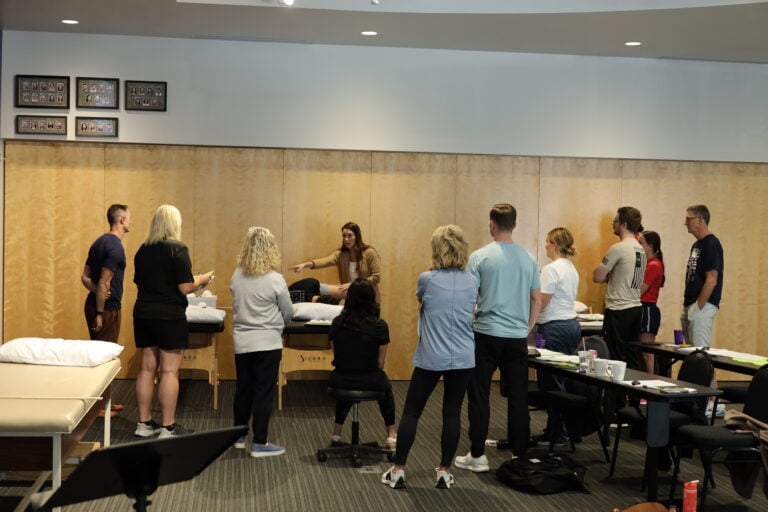
Traveling to Lincoln to teach from the heart of PRI is a fulfilling trip, even caught a Nebraska volleyball win in person. The weekend flew by and this was also a reflection of how engaged and attentive the attendees both in person and virtual were during Myokinematic Restoration. We dove right into exploring the relationships between pelvic positioning, femoral orientation, and compensatory strategies upright humans exhibit during forward locomotor movement often referred to as gait. During lab demonstration, we were able to assess if the L AIC pattern was present and then further testing with the EXT drop test, the capsular integrity of the anterior hip capsule. We ended the first day with repositioning techniques to help inhibit the L AIC pattern. As an instructor, it was rewarding to hear clients begin connecting the dots between the asymmetrical human position and how the techniques can be so powerful to change position on a neurological level. Reports of “feeling lighter” or “more grounded” were reported several times during lab.
The second day we explored the Hruska Adduction lift test and its respective grading scale. We used this assessment to determine the ability for one to be able to lateralize on the left and right side as well as shift to the opposite side correctly. This test requires frontal plane integration without the over use of sagittal plane muscles acting in the transverse plane. Such an important test when treating patients and prescribing appropriate techniques. The lab in the afternoon gave us plenty of time to work through several techniques that were reflective of different grades of the Hruska Adduction lift test.
I am continually grateful for the opportunity to share PRI science. Thank you to the course attendees both local and virtual for the passion and questions on your learning journey.
– Kasey Ratliff