
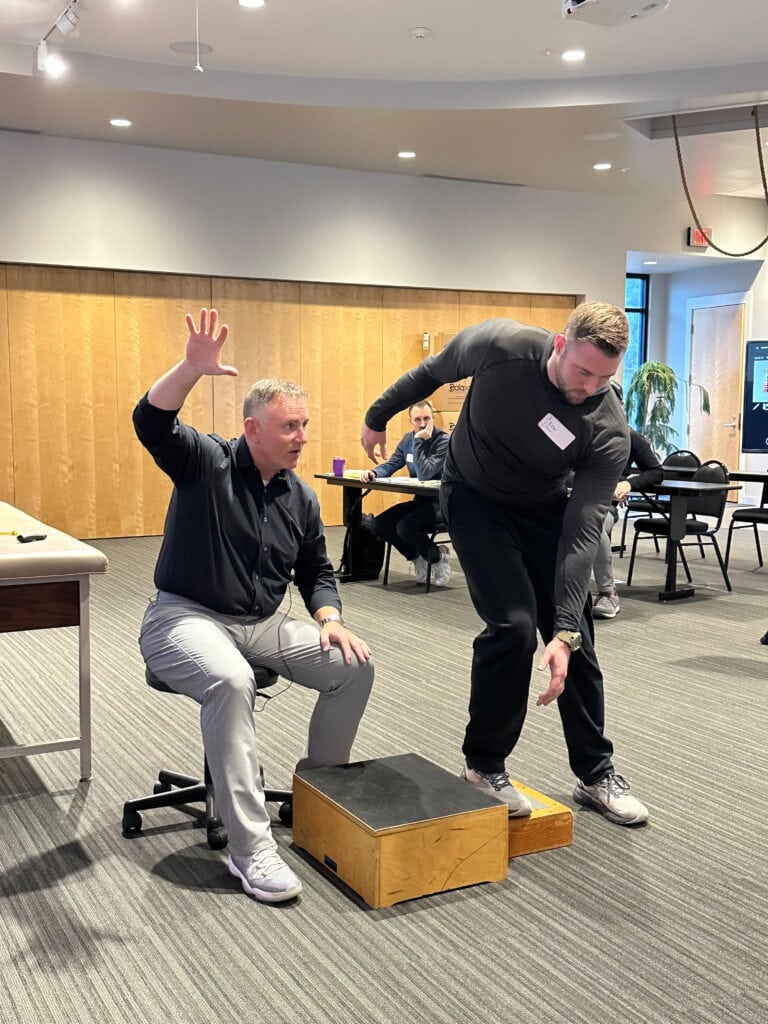
Impingement and Instability has had the pleasure to kick-off the new PRI educational calendar for the last several years. It’s a great course to establish a solid neurobiological foundation for the PRI Secondary and Tertiary courses. It was my distinct pleasure to help PRI practitioners on that journey, and this most recent course was no exception.
We’ve said this many times, but I&I was revamped six years ago to be a much more neurologically based course, pumped full of research. One of the bigger concepts we discuss is how valuable the sense of interception is, how to access it, and how unilaterally biased it is, based on research. We spend a lot of time discussing and demonstrating how asymmetrically powerful our vestibular senses are, and how those concepts are perfectly paired with PRI concepts.
We were able to have the time to demonstrate these concepts in two different manners, and how the sense of interoception is far more powerful that the sense of muscle contraction. By a wide, wide margin. This is typically the first course in which we have the opportunity to explain and demonstrate that the musculoskeletal system is a means to an end, rather than a desired end result. As a result, the attendees have a valuable opportunity to see and feel how intensely valuable the sensory system is to position and musculoskeletal performance.
This course has four unique PRI Non-manual techniques that capitalize on the conversations around pressure, neurobiology, and human asymmetrical sense of self that can only be found in the I&I course. These four unique PRI Non-manual techniques are a bridge to the rest of the PRI Secondary and Tertiary courses. It is a far more valuable experience for the live stream course attendees if there are in-person attendees available to perform these, as well as other, non-manual techniques because our discussions of reference centers and sense of pressure are better sensed than explained. My thanks to Ben Mix, Morgan McBee, Will Baum, and Eric Menchi for their attendance in-person, and their willingness to allow us to learn from them. We had a wonderfully diverse group of movement professionals attending via live stream as well. We had individuals in attendance from six countries outside of the United States, as well as seven individuals who have earned the distinction of Certification from the Postural Restoration Institute.
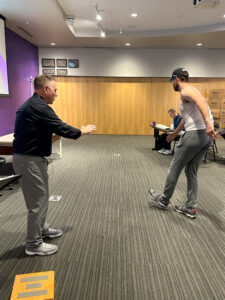
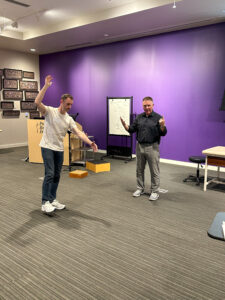
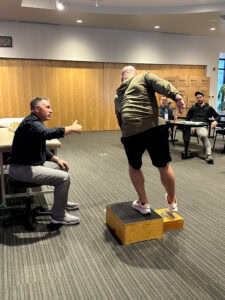
We had wonderful questions, dialogue, and conversation. I hope it was as rewarding a experience for those in attendance as it was for me as an instructor. The unique qualities of this course, as well as the exclusive PRI Non-manual techniques found only in this course, provide the attendee with different perspective on human performance and how to help humans better integrate their asymmetrical hemispheres of the brain through an improved sense of interoception via pressure management in several of regions of the body. If you are interested in progressing and advancing your knowledge of how the asymmetrical human brain works for motor function and how to better apply PRI concepts during selection and coaching of PRI Non-manual techniques, Impingement and Instability is a great way to begin that journey.
Looking forward to a wonderful 2026!
– Dan Houglum