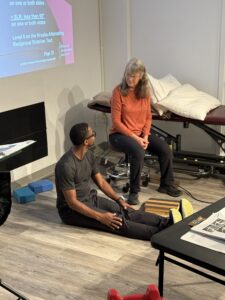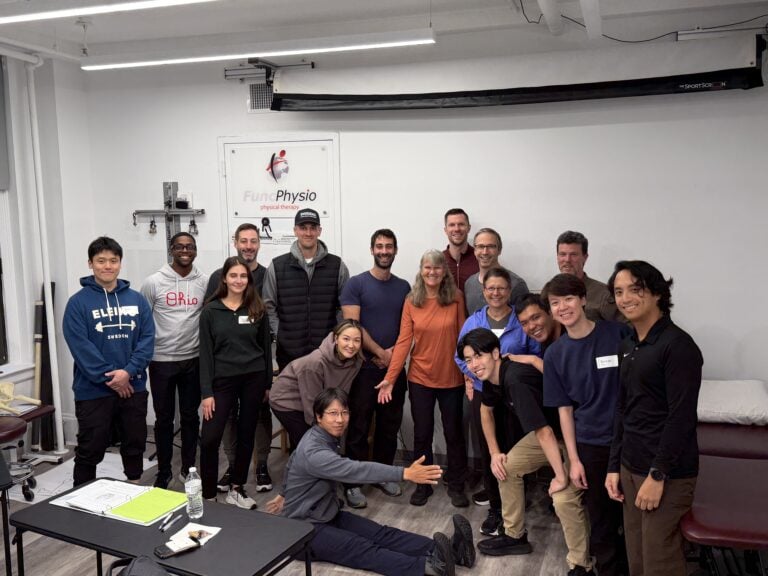
I have taught Cranial Resolution for several years now and although I have witnessed more than a few individual ‘Ah ha’ moments throughout each rendition, it wasn’t until I taught it at FuncPhysio in NYC earlier this month that I sensed a truly significant collective one. It seems, from the questions and comments that were being exchanged throughout the weekend, that the entire group, which was dominated by ‘cranial newbies’, were grasping the underlying (tertiary) concepts in a clinically relevant way. And even someone who had attended the course several times before stated that they “now understood the paradigm itself so much better.”
These comments indeed make me proud, since I admit that I have spent a monumental amount of time trying to understand, scientifically support and figure out a way to palatably deliver the comprehensive material that Ron Hruska collected and organized while developing this Cranial Resolution Course. However, I do not believe that my delivery is the main reason people are “finally getting it.” I think I am simply lucky enough to be teaching it now, at this moment in time when the world, especially those in the PRI world, have been primed and are ready to accept how the physical, physiological and psychological realms integrate and evolve with one another. Between the way the primary, secondary and other tertiary courses (and an extensive number of PRIVY episodes) have introduced and progressively developed neurological concepts, explored the role of perception, discussed the need to empower gravity, etc, etc, they have piqued the interest and made the concepts that are more systematically covered in Cranial less foreign.
The primary and secondary courses focus on patterns and teach “physical” re-positioning techniques to get people to change them, whereas Cranial Resolution simply focuses more on the physiological changes that occur the moment you have someone ‘breathe in through their nose’ in that new position. When teaching, it is fun to watch people suddenly gain a whole new appreciation for that sentence and understand why it is repeated in every single non-manual technique. The earlier courses do such a good job of laying out these concepts so that Cranial Resolution can take it to the next level.
The other tertiary courses address how we use occlusal, visual, vestibular or vocal referencing to recognize and/or change our (psychological/behavioral) sense of self. This sense of self, however, is a product of how we cranially resolve tension throughout our entire system to filter sensory input and/or afferentation. Understanding the predictable influence paired sensory inputs can have on a person’s autonomic response can be empowering. It is such a joy to watch course attendees suddenly understand WHY they may want to temporarily put a cone in someone’s hand, foam in someone’s shoe, something between someone’s teeth, a hat with half the visor cut away on someone’s head to block a dominant superior visual field or put cotton in someone’s nostril or ear.
What I got to see in NYC earlier this month was Cranial Resolution remove some of the “magic” of PRI and replace it with science. That being said, the course still had its share of magic, especially on day two when a 4-hour Hispanic parade passed along the street below FuncPhysio, pulsing Latin rhythms through the entire facility while Neal Hallinan, the PRI king of Latin rhythms was sitting in the front row. Me and my right cranium couldn’t help but smile.
I also want to give a big shout out to Yohei and all the great folk at FuncPhysio. What a bright, warm, and welcoming group of individuals. They could not have been more helpful (like when my computer stopped working with their system) or more receptive. Thanks.
– Jennifer Smart