
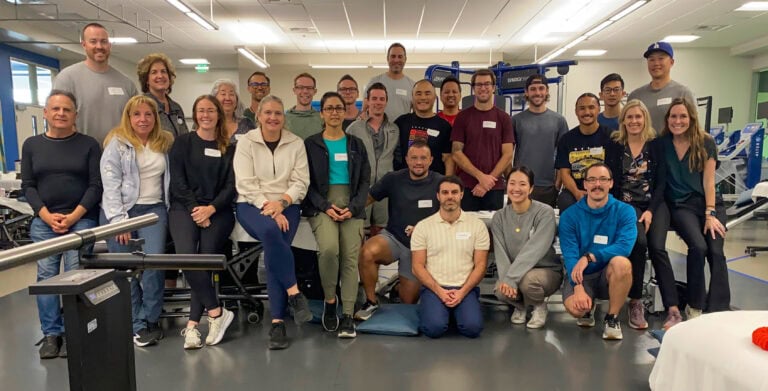
Like their beloved LA Dodgers, repeat World Series Champions, the Henry Mayo clinic has become a dynasty host site for PRI courses. MVPs John Adam, Julie Barker, PT, and Thomas “TJ” DiPrima, PT, ensured a comfortable space for a weekend of learning. We had an All-Star group of attendees, including fellow faculty and ace pitcher Kasey Ratliff, PRC, – who shared many insights in the clinical application of this complex material – and Cody Gillis, PRC, Jarrett Kolich, PRT, and Locatelli “Loc” Rao, PRC.
Two dentists in the audience, Sarah Phillips, DDS, and Ramin Partovy, DDS, served as designated hitters, increasing production and depth to our discussions on the dental implications on patterned cervical and cranial position. Your perspectives were greatly appreciated!
Rounding out the line-up were our avatars: Glen Gomez, DPT, Daniel Loub, CSCS, Tara O’Brien, DPT, Brandon Partovy, DC, David Shamash, CPT, and Wendy Honoka Shiva, DPT. They served as real-life examples of how overactivity of one side of the temporo-mandibular cervical chain of muscles assists the nervous system in upright management and navigation of the environment. Our atlas and lumbar spine orientation trigger a cascade of accommodative positions of the remaining spinal segments. With every step, forces are directed into the cranium, coalescing at the spheno-basilar junction and redistributed throughout the cranium.
As we know, our left cortical and right hemi-diaphragm dominance hold us in right stance. When alternation of our brains and bodies is limited – e.g. we sit too long and don’t shift enough – the spheno-basilar junction becomes patterned in its position. The most common pattern is the left sidebend position which, in turn, directs the temporal, sphenoid, maxilla, and mandibular bones. Over time, morphological changes in appearance takes hold, with mal-occlusion, and mal-neurological processing driving symptomatology, like TMD and headache pain, disc herniation, etc. The stage is now set for a pathological cranial position – right torsion – beget by trauma. Along with movement retraining, intervention by optometrists and dentists is critical in the management of these individuals.
Thank you to all attendees for your many questions and comments and diligence in mastering the cervical tests and techniques, with the left lateral pterygoid closing out the game. Looking forward to seeing you all again at future courses!